


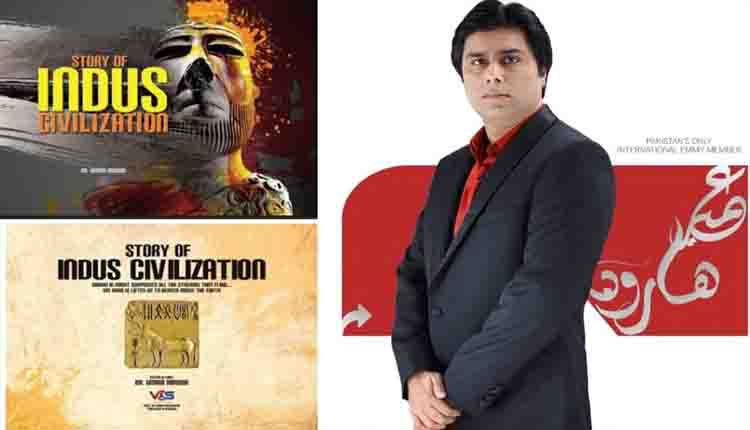
What if the Indus was never just a river? Dr. Umair Haroon’s Story of Indus Civilization (digital edition, 2021) forces readers to confront that question from the first pages. The book reframes the Indus known historically as the Sindhu as the enduring artery of one of the world’s earliest urban cultures, a force that shaped settlement, trade, identity, and memory across millennia and still echoes in South Asia today.
Spanning more than twenty chapters, the work traces the region’s arc from prehistoric roots through the Early, Mature, and Late Harappan phases (including major centres such as Harappa, Mohenjo-daro, and Dholavira), into the Iron Age, Buddhist influences, successive dynasties, and finally the modern cultural landscape of Sindh. Haroon, a journalist by background, writes with a storyteller’s clarity rather than an academic’s density. The result is an accessible, visually rich volume that functions almost like an illustrated cultural chronicle or coffee-table companion: high-quality photographs, maps, historical reconstructions, and period illustrations are woven directly into the narrative so they illuminate rather than merely decorate.
The chronological backbone is clear and useful. Readers move from pre-Harappan settlements and the Kot Diji and Ravi phases into the sophisticated Bronze Age cities of the Mature Harappan period (roughly 2600–1900 BCE), then through later transitions. Interspersed are memorable historical asides: Alexander’s encounter with the Indus (which he initially mistook for the Nile’s source), the Mauryan Empire’s role in placing the region on broader trade networks, the long history of Aror (modern Rohri) as a capital, and the complexities surrounding Muhammad bin Qasim’s arrival and the rule of Raja Dahir. These details keep the narrative lively without sacrificing the larger civilizational thread.
After establishing the timeline, the book shifts into thematic territory. It explores spiritual continuities from early Vedic and Buddhist traditions through the arrival of Islam and the deep imprint of Sufism highlighting practices of coexistence that have marked the region. Substantial attention is given to Karachi’s evolution across Mughal, Kalhora, Talpur, and British periods, including administrative changes and major infrastructure. Chapters on art, architecture, and urbanism survey forts, shrines, bridges, and historic city planning, while others turn to living culture: folk music and poetry, cuisine, the iconic Ajrak textile tradition, crafts, the development of the Sindhi language, early literary figures, and contemporary identity, including the diaspora and cultural revival. Even sites such as the Gorakh Hills receive mention, reinforcing the book’s broad geographic and cultural scope within Sindh.
The volume’s greatest strengths lie in its inclusivity of popular heritage and its design. It succeeds in making thousands of years of history feel immediate and inviting for general readers, students, and heritage enthusiasts who may find denser archaeological monographs forbidding. Haroon’s evident passion for the subject gives the pages an engaging energy. At the same time, the prioritisation of narrative flow and visual appeal means the book largely forgoes extensive scholarly apparatus and footnotes. Some claims are presented as settled fact, and the strong Sindh-centric lens can leave other regional perspectives less fully explored. These are understandable trade-offs for a work aimed at a broad audience rather than specialists.
Overall, Story of Indus Civilization stands as an ambitious and attractive introduction to the deep history of the Indus region viewed primarily through Sindh. It is less a technical excavation report than a cultural artifact in its own right one that preserves and popularises a rich legacy for libraries, classrooms, museums, and curious readers. For anyone seeking an accessible, well-illustrated journey from ancient village settlements to modern Sindhi identity, Dr. Umair Haroon’s book offers a compelling and visually rewarding entry point, one that complements more specialised studies while inviting further exploration.

Comments are closed.